
Nonprofit Law
How Much Does It Cost to Start a 501(c)(3)?
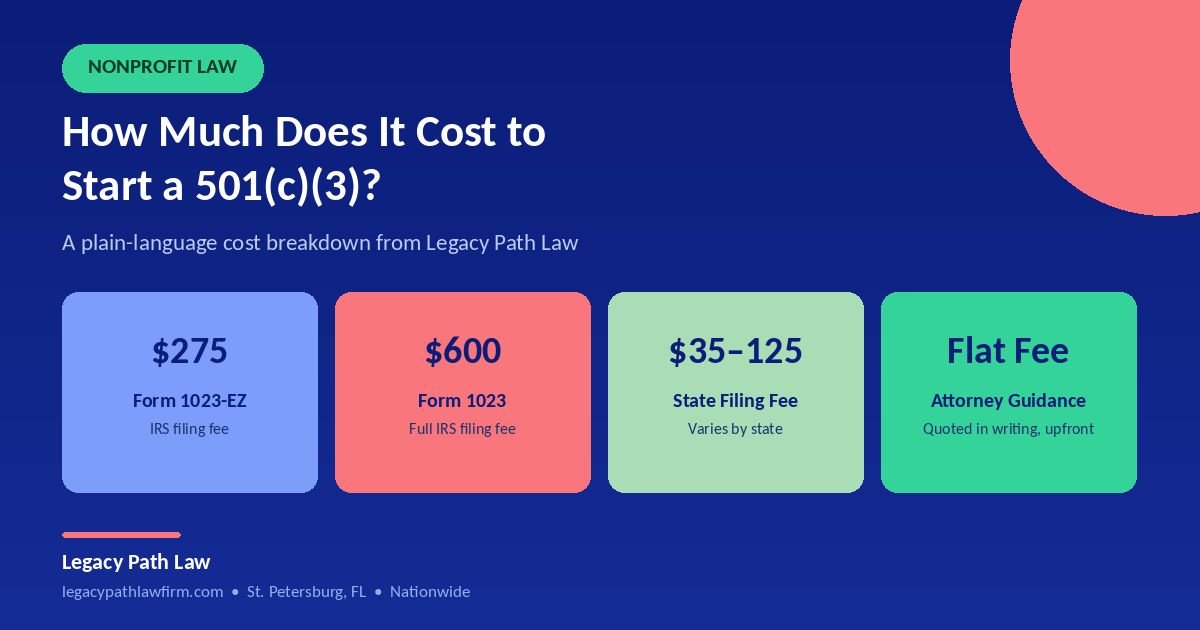
Starting a 501(c)(3) costs $275 or $600 in IRS filing fees depending on which application you qualify for, plus a state incorporation fee that generally runs between $35 and $125. Attorney fees are the variable, and they are the part worth understanding before you choose the cheapest option.
The honest answer is that it depends on how you file, where you are located, and how much assistance you want along the way. Here is a straightforward breakdown.
1. The IRS filing fee
Every nonprofit seeking 501(c)(3) federal tax-exempt status has to file with the IRS, and the fee depends on which form you use.
Form 1023-EZ: $275. Only certain nonprofits qualify, and choosing it when you do not actually qualify is one of the most common, and costly, mistakes we see. If your application is rejected, you have lost both the fee and the time.
Form 1023: $600. This form is required for larger or more complex organizations — churches, hospitals, schools, and nonprofits expecting significant revenue from the beginning.
2. State incorporation fees
Before you can apply for federal tax-exempt status, your nonprofit has to be legally formed as a nonprofit corporation in your state. That filing fee varies state to state and generally falls between $35 and $125.
3. What DIY filing does not include
Filing services and templates can help you submit paperwork, but they cannot tell you whether your bylaws satisfy IRS requirements, whether your stated purpose will survive IRS review, or whether your board structure creates a problem you will have to unwind later.
Getting any of this wrong does not just cost time. It can mean a rejected application, a delayed launch, or a nonprofit that is technically incorporated but never actually tax-exempt.
4. Attorney fees, and why flat fee matters
Attorney fees for nonprofit formation vary widely, which is exactly why we quote ours in writing before any work begins. You know the full cost upfront: no hourly surprises, and no “it depends” on the invoice.
The real cost comparison
The cheapest path on paper is often not the cheapest path overall, once you factor in:
- The cost of fixing a rejected application
- Delayed fundraising while you wait on IRS review
- The risk of an improperly formed board
- Paying taxes if you do not obtain tax-exempt status
- Lost donations from donors who need a tax deduction
A flat-fee attorney closes that gap. You get licensed legal guidance and a predictable number at the same time.
Ready to talk through your nonprofit’s filing?
Schedule a consultation or learn more about our 501(c)(3) formation services.
IRS user fees are current as of publication and are set by the IRS; confirm the current amount before filing. This article is for general informational purposes only and is not legal advice.
Know the number before you start.
Flat-fee 501(c)(3) formation, quoted in writing before any work begins.